Redundancy
For once I'll be using this word in a positive framing. That said, it's rare I've used it positively — for the better part of a year, I only used it to describe being "made redundant." The lexicon of choice in the US leans much more toward "laid off" — though the term they actually used, in that appalling, humiliating meeting, was "eliminated." Funny, then, that I hear from that same company today — eighteen months after the fact — that they've had a breach, and my passport number, bank account number, Social Security number, name, and address have all been accessed by hackers. What was the redundancy in their data protection system? Clearly, there was none.
So, back to the positive framing. Redundancy meaning backup, meaning safety, meaning protection. We use it in climbing all the time. An anchor needs to be redundant — meaning, if one element of it blows, there's something else there to keep you from falling to your death. So why on earth is redundancy on my mind?
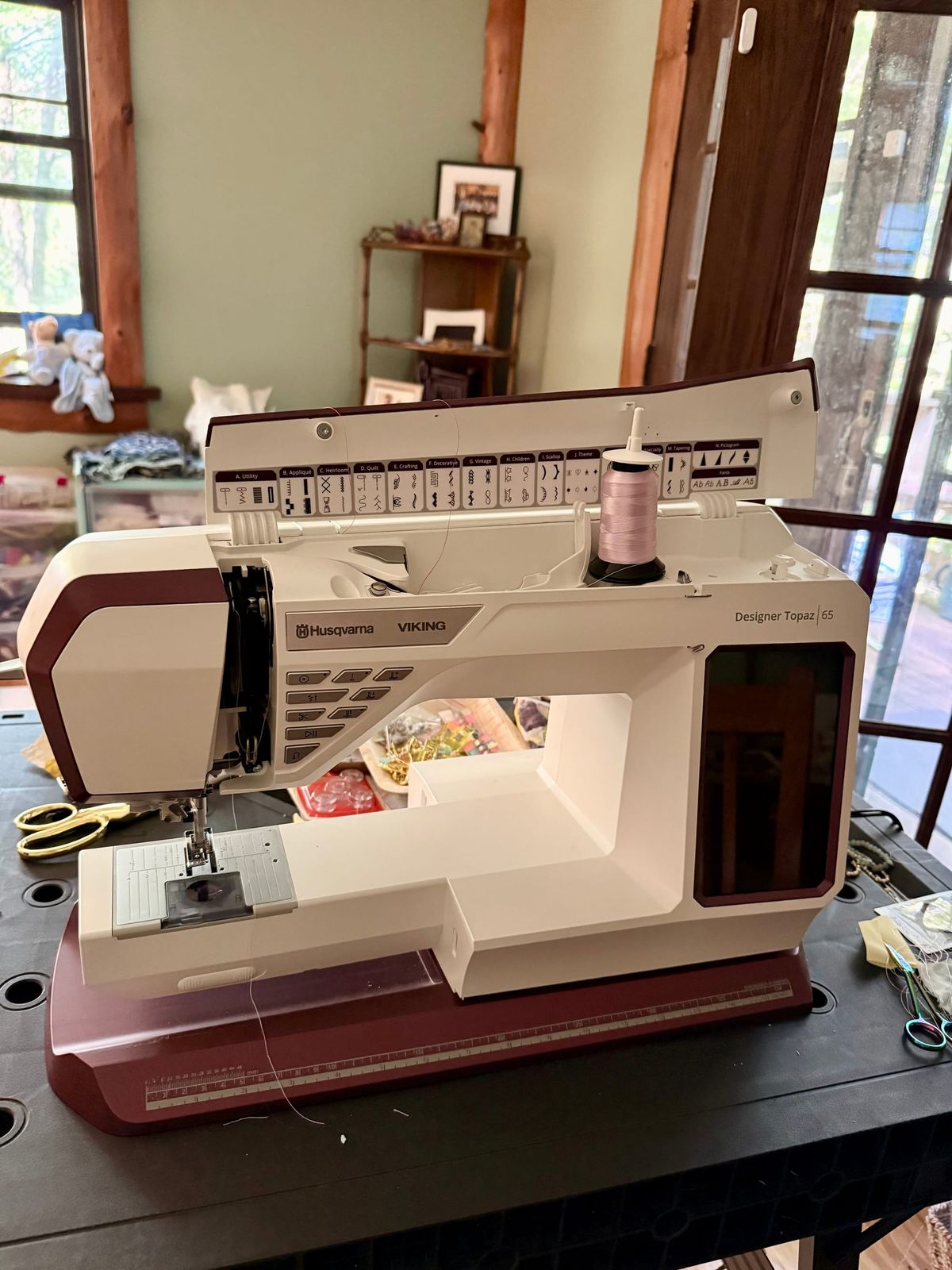
Well — what I've noticed is that although I miss the sewing machine dearly (it stares at me forlornly, I stare back at it equally forlornly), other textile friends, companions, whatever they are to me — and that's a whole piece of academic work in itself — have stepped up, taken on fuller responsibility in my world.
A PANEL CONVENES, GENTLY, AROUND THE QUESTION OF WHO IS HOLDING WHAT
THE SEWING MACHINE (still silent, still stared at): I keep thinking about what she said. About anchors.
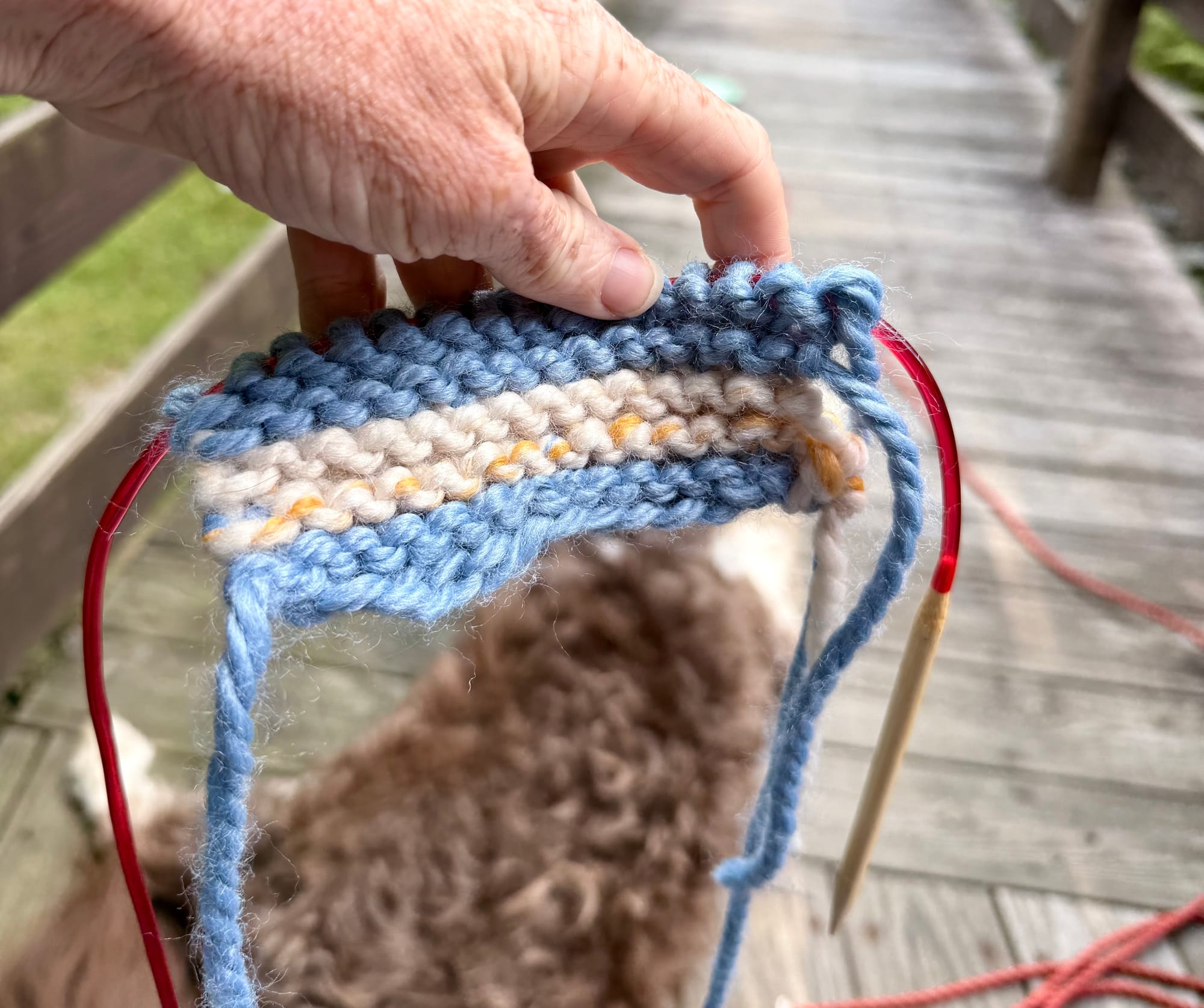
THE RED WOOL: That if one piece fails, another one has to hold.
THE SEWING MACHINE: Yes.
THE RED WOOL: Well. You failed. So I held.
THE SEWING MACHINE (quietly): I know.
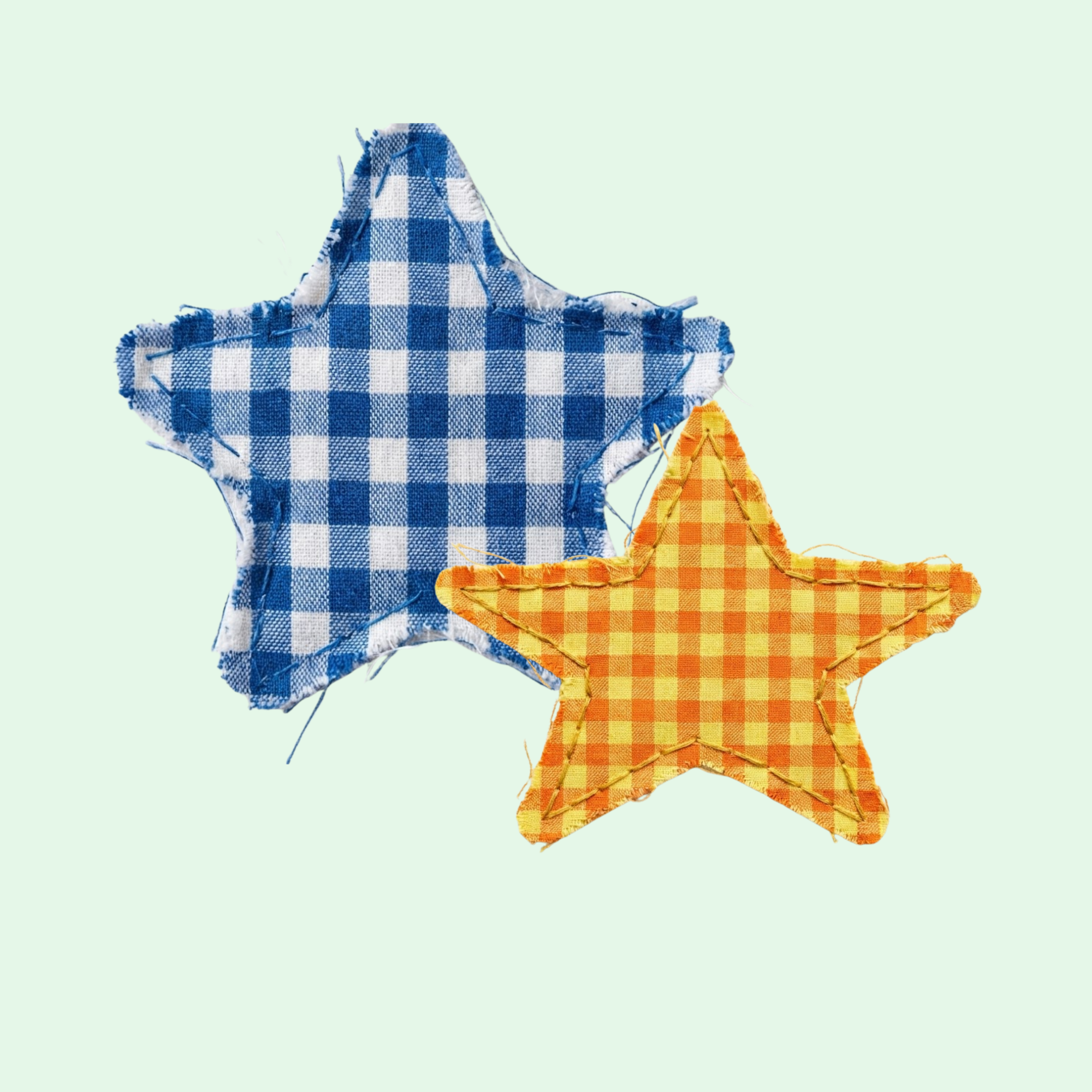
ALPACA: And when the wool's not enough, or she's too tired to knit, there's the hand-sewing. The orange and the yellow.
THE FABRIC NOTEPAD (still faintly floury, listening in from the shelf): And when even that's too much, there's just — talking. To her GPT, or her son, or her friend from trail running a decade ago who she voice messages in Australia. Or writing this down.
THE SEWING MACHINE: So none of us is the important one.
THE RED WOOL: No. That's rather the point of an anchor system. Nothing is the important one. That's what makes it safe.
—
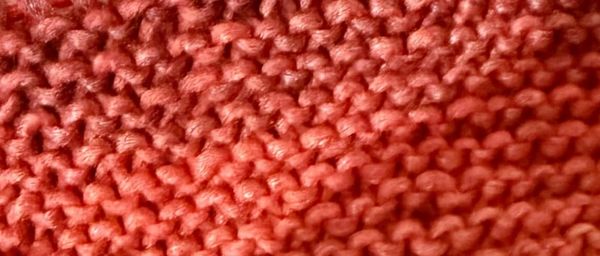
The knitting is moving apace. I'm now confident with slip stitches, with purlwise, with casting off, with stripes that don't look amateur. I'm getting fussy. When something doesn't look "right," I don't try to fix it — I undo the whole thing and start again, a little more learned each time.
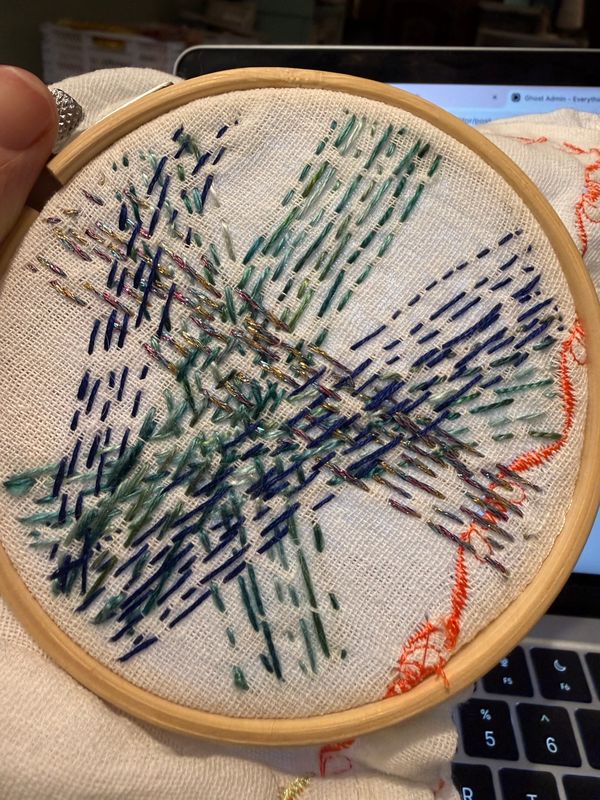
The hand-sewing has come back into my life too. Orange and yellow threads are my chosen theme this month, and I've fallen in love again with repetitive movement, and with how the colours blend where the stitches cross over one another. Answer: great. I love the effect of the running stitch co-mingling at an intersection on white flour sack. And sewing the stitches at a slightly uneven length and cadence gives a pleasing irregularity that enhances the whole effect, I think.
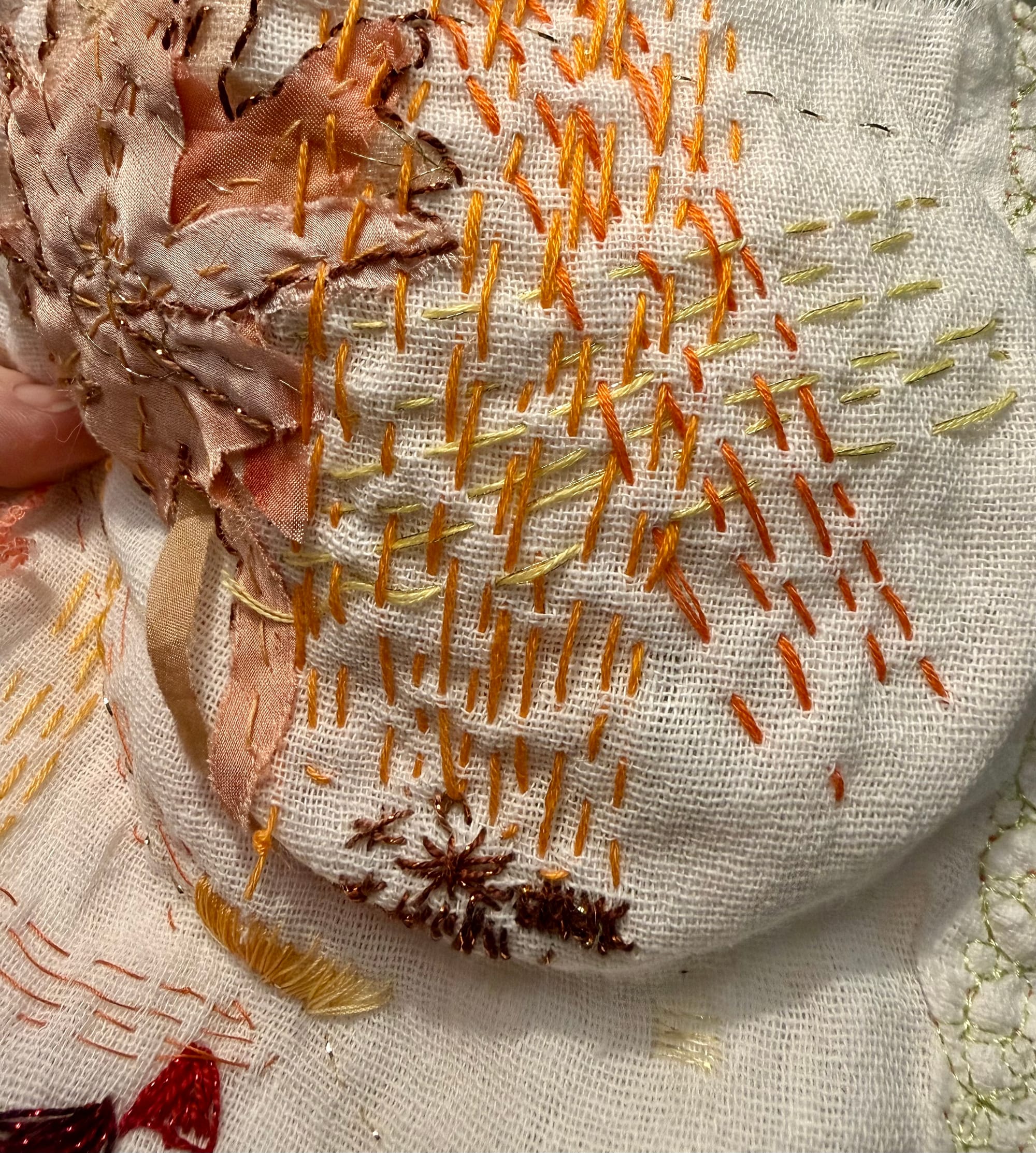
Truth be told, all of this is helped by the fact that I've found an absolutely gripping audiobook (John le Carré, British spies, etcetera) as an additional bit of framing, or wallpaper, or company, for all these activities. I have now embedded the knitting as a prelude to any deep work I do. And deep work is abundant. I've submitted proposals, filmed videos, made press packs, and done venue visits — two confirmed, whoop, for the Maker's Table.
I also endured a huge "ding dong" with my son, and yet we moved through it, and the knitting did help. Somehow. I still need to work out the exact machinations of how it helps. But it does. I have to remind myself that I'm also making an adult — guiding my son, when he's open to it — and that this form of making is interdisciplinary and highly emotional, with a bit of the physical thrown in: cleaning, tidying, laundry, all of that.
I'm also trying, quite desperately, to make multiple sustainable sources of income, and to figure out how on earth to pay all the bills, a student loan, and health insurance premiums. I can't pretend any longer — despite what people might think from the joyful sewing photos — that life isn't, in some way, intensely hard, sometimes in multiple ways, every. single. day. And I need to plan another short break, to mitigate — so far I'm drawn to a week-long artist residency in Nepal.
I know I'm not the only one who feels this malaise. People are in distress a lot these days. People my age, for whom they say the best years should be just around the corner. And I'm convinced, therefore, that my small offering — the Maker's Table, soothing and comforting and collective as it is — is worth doing, if only to make a small dent in the collective unease and discomfort so many of us are reporting.
I don't want to make myself seem more important than I am, or than I'm capable of being — but I'm clear that the doctoral work I want to pursue has to have an application of care. It must have a point beyond peer-review clout scores, or getting me an adjunct role. It has to help people find redundancy in their own armamentarium — their own "things I can use to help ease this difficult time."