Seafoam
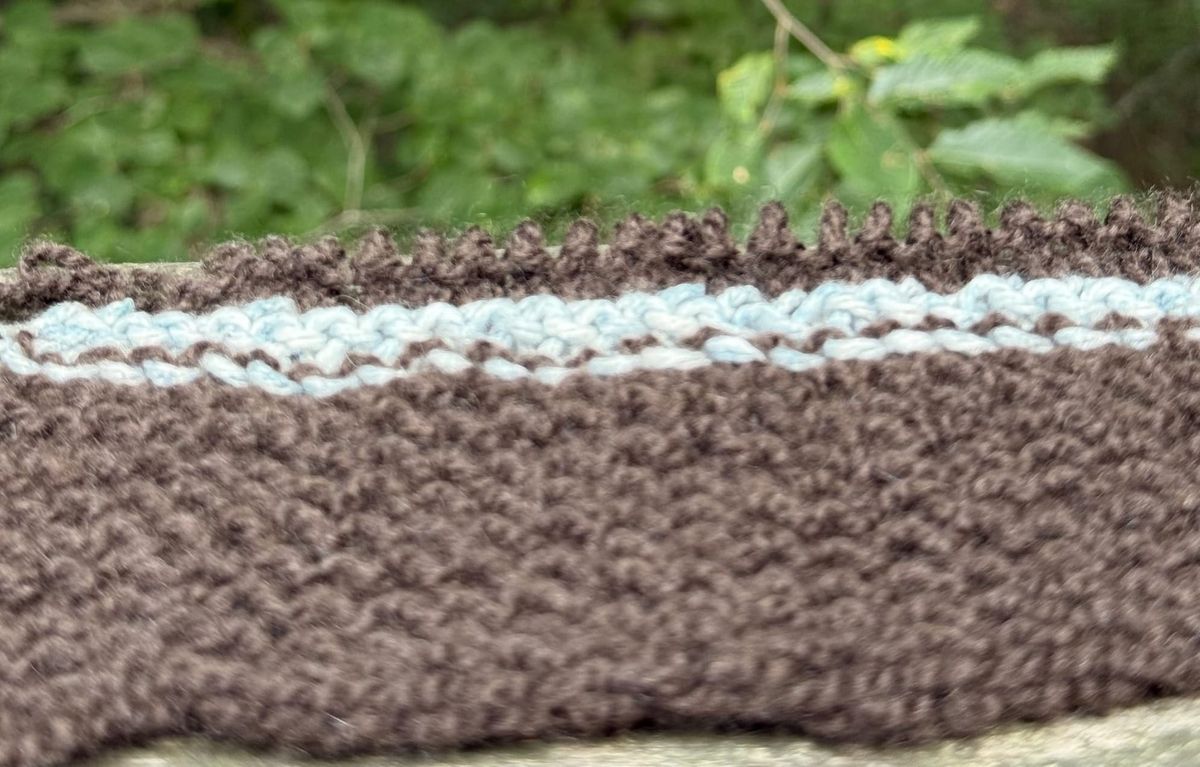
I decided to cease production on the first piece of knitting I made as an adult.

I decided to cease production on the first piece of knitting I made as an adult.
The piece had become unwieldy, even to me. Its eclectic concoction of different yarns and colors had already proven a point: that textiles can coexist; that no single yarn needs to dominate; that yarns across species can entangle without issue. But as I continued, the piece slowly lost its shape. Threads wandered. It became, well, messy.
The materials told me we had reached a point of completion.
Keen as I am to continue learning to knit, and with ambitions of one day making a soft blanket of many colours and/or a winter beanie, at some point later in the day, I began again. Smaller 'circular' needles from a well known online retailer with a strange smell mentioned in the five star reviews. Fresh yarns - from a pure-player wool retailer, no smell other than the lush aroma of wool. Digging around in the paper bag in which the yarns pleasingly arrived (no plastic lover here) I let the yarns speak to me, and the chocolate-brown alpaca called the loudest.
ALPACA: (I did. I don't do hesitation.)
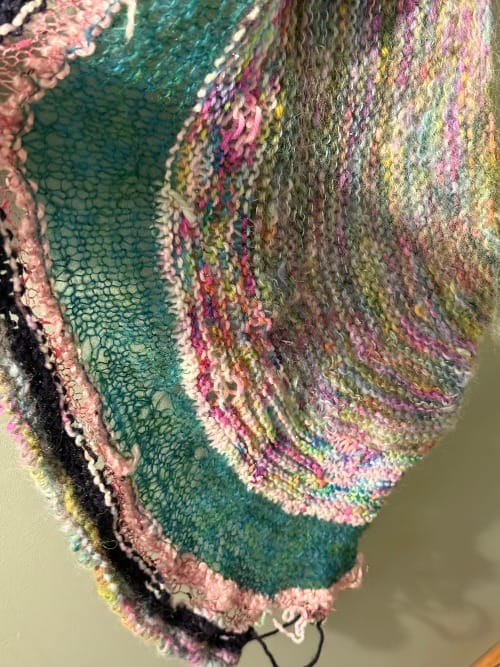
What emerged was another garter stitch creation (the only stitch I as yet know how to knit), which, despite my original intentions, seems to be quietly becoming an old-fashioned British boarding school scarf. If you're British you know the type, stripey, with the house colors, too long and sort of easy to pull, or to use as a garotte. This particular boarding school's insignia was brown, then came a seafoam-off-blue (cotton yarn). I didn't begin with any intention of pairing the two.
More to the point, in case you get the wrong idea about me - I did not go to boarding school, and for the record, my school colors were bottle green (yes not just any green but bottle green) and gold. Which meant yellow. No expense to be wasted on golden thread in our polyester cardigans.
The seafoam-colored yarn arrived in the scarf in the becoming because I simply wanted to touch this yarn. In the skein it magnetized me.
Of course, once I touched it, although I didn't love its rather dry and rough texture, I had to just, well, unwind the skein a little. I managed, not for the first time, to transform something beautifully ordered into a tangled mass with remarkably little effort. I stayed with it, imagining the task might soothe my jet-lagged brain. I have only just returned to the United States from Europe.
Instead, the experience oscillated between small moments of calm when the strands flowed freely, and flashes of guilt whenever another knot tightened making yet more micro-mess. The guilt did not surprise me. The yarn was expensive, brand new, and I felt somehow responsible for creating this disorder through inattention. I have a reverence for materials these days. In these times of scarcity for the planet, and additionally for me. Still rebuilding after losing my corporate career.
Eventually, I took the scissors to the pile of blue spaghetti.
Fifteen small balls of yarn emerged.
x x x x x x x x x
A MORE THAN HUMAN MATERIAL PANEL CONVENES, BRIEFLY, ON THE SUBJECT OF THE FIFTEEN BALLS
THE RETIRED PIECE (unravelled, decommissioned, still sitting in a heap in the corner): She'll tell you she doesn't love chaos. But then ask her about her kitchen cabinets. I rest my case.
SEAFOAM COTTON: I'd like it on the record that I am not rough, and I was not "disordered." I was mid-transformation. She's the one who panicked and reached for a story about her own inattention.
ALPACA: You did tangle rather dramatically.
SEAFOAM COTTON: User error. Don't blame the materials. She needs to learn how to handle me.
THE LOOM (from the hallway, uninvited): Nobody asked me to this panel, which tracks, since nobody's asked me anything since March.
THE RETIRED PIECE to the LOOM: She's still not finished with you because she doesn't know how to end things gently. She'd rather declare a piece complete than admit she's lost interest in it.
ALPACA: That's unkind.
THE RETIRED PIECE: I've been strung up as a decoration, gathering dust and moth wings on her bookshelf. That feels unkind.
SEAFOAM COTTON: For what it's worth, I don't mind being cut. Fifteen small futures instead of one long tangle seems like an upgrade.
THE LOOM: (quietly) Send a few of those futures my way.
x x x x x x x x x x
Looking at those fifteen small off-blue balls, I realized they were perfect. They could introduce brief rows of color into the growing brown softness of the 'pedagogical' scarf. They could also find a home in the loom weaving I began months ago and have yet to finish.
The loom calls to me every time I walk past it, which is frequently because it lives beside the bathroom. And yet I resist it, partly because I no longer like the colors I originally chose for its adornment. Perhaps the seafoam has been listening after all.
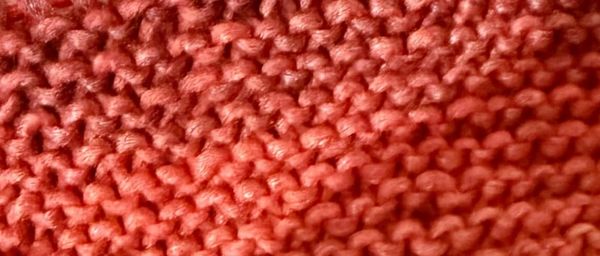
The cotton, despite its roughness, or maybe because of it, forms looser stitches than the alpaca, but I find myself delighted by the way the blue and the brown entangle, by the quiet argument between the warm brown and the cool blue-grey — an argument, I've decided, not a conversation. Materials don't search for resolution or harmony. We impose it upon them. But why?
Elsewhere in my life I am also making a curry for Stan and me to eat tonight. I am making a home through laundry, folding clothes, and the ordinary maintenance, ergo matters of care, that keep this tiny family of three together. I am making a stronger body, as I am about to work out.
And tonight, I hope, I will begin making a nightdress.